2nd October 2024: Bucharest
Just after 1 a.m., I collected a rather weary-looking Sean from outside his house, then trundled across Harborough to scoop up Jim before heading out of town to rendezvous with Suraj in Rothwell some twenty minutes later. Our little band of adventurers was off to Transylvania to soak up a bit of Romanian culture, and, with any luck, uncover the truth behind Bram Stoker’s infamous Count Dracula. Garlic was not officially packed, but one can never be too careful.
As seems to be the new tradition when driving to any airport in the dead of night, we encountered the obligatory detour courtesy of overnight roadworks, this time near Cambridge. The delay was mercifully brief, just nine minutes, but still irritating enough to warrant some light grumbling.
A short stroll from the nearby short-stay car park brought us into the terminal, and before long, we were through security and tucked into a Wetherspoon’s breakfast. Nothing says “holiday” like a full English at 4 a.m., accompanied by coffee strong enough to reanimate the dead, just in case Dracula wasn’t waiting for us.
Our flight departed on time at 6:20 a.m. and was fully booked. In the spirit of frugality, we’d opted against paying extra to sit together, and so were scattered across the cabin like budget-conscious confetti. The two-hour-and-thirty-five-minute flight passed without incident, and it was a pleasant surprise to step off the plane into a warm, sunny Romanian morning, a welcome contrast to the brisk chill we’d left behind at Stansted.
With several transport options available to reach our city-centre hotel, we opted for the train, a bargain at around £1. It dropped us in the heart of Bucharest, and from there, guided by Google Maps and British stubbornness, we embarked on a half-hour walk. The traffic was heavy, slowing us down at every crossing, and the pavements were a minefield of uneven slabs and creative trip hazards, not ideal when running on minimal sleep.
The Parliament Hotel, however, was well worth the hike. Situated in Bucharest’s grand Parliament district, it’s surrounded by architectural opulence in every direction. From our bedroom window, we were treated to views of the imposing Parliament Palace and the People’s Salvation Cathedral, both of them world record holders and certainly not shy about it.

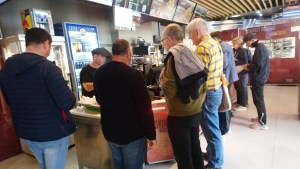
After dropping off our bags, we wandered a short distance to a fast food outlet charmingly named ‘Chicken Staff’, heartily recommended by the hotel receptionist, though whether she genuinely liked the food or simply enjoyed watching tourists attempt to eat their bodyweight in poultry remains unclear. Feeling thoroughly stuffed after tackling an enormous chicken wrap of frankly architectural proportions, we returned to the hotel, checked into our rooms, and indulged in a well-earned hour and a half of rest before venturing out once more to explore the bars of the Old Town.
We soon found ourselves navigating a lively warren of cobbled streets, teeming with people and pulsing with music and chatter. But just as we began to absorb the atmosphere, I received a difficult phone call from Jamie with some very sad news about Rocky.
Earlier that day, Rocky had been put to sleep by the vet, his pain finally at an end. Jamie asked if he could bury him in our garden, and we agreed on a spot beneath the Ginkgo Biloba tree, the very place Rocky had always chosen to relieve himself during his visits. A fitting tribute, in a peculiar sort of way.
I had a real soft spot for that proud little dog. Despite being deaf, blind, and increasingly eccentric, Rocky never once accepted the idea that he was old. He would trot tirelessly around the garden, seemingly fuelled by sheer defiance, and was always up for an ear fondle. I shall miss the comforting weight of his warm little body curled up against me during evening TV. He may have been small, but he left a sizeable hole.


The Old Town is the place to be in the evenings in Bucharest. While much of the city was bulldozed and reimagined in grandiose communist style during Nicolae Ceaușescu’s notoriously oppressive regime, think wide boulevards and hulking, joyless concrete structures, this charming little pocket of cobbled streets somehow escaped his architectural ambitions. It’s now a bustling maze filled with restaurants and noisy bars, each vying for attention with outside seating and waitresses employing a colourful array of one-liners to lure you in. Respond, even vaguely, and you’ll find yourself caught in a cheerful verbal tug-of-war and almost certainly seated within moments.
We sampled a few establishments, soaking in the atmosphere (and a modest amount of local beer), before settling on a large venue that delivered an excellent cheese platter accompanied by some splendid Romanian ale. A fine pairing, if perhaps not what Dracula would have ordered.
On our way back to the Parliament Hotel, we discovered to our dismay that the hotel bar was just closing. However, on solemnly swearing we would only have one drink each, the staff took pity on us and provided the essential sustenance required after a half-hour trek on weary feet. The nightcap was most welcome.
3rd October 2024: Transylvania
We were up bright and early at 6 a.m., bleary-eyed but determined, and soon showered and in reception to collect our packed breakfasts, mysterious brown paper bags full of promise. A taxi took us to Piata Universitatii, where we were due to meet the coach for our tour of Transylvania.
Even at that hour, Bucharest was already buzzing: traffic was thick, pavements bustling with early commuters and the city showing no signs of slowing down for anyone. Nevertheless, we arrived in good time, boarded the coach without incident, and settled in for the day ahead, ready to venture into Dracula’s homeland and see what eerie delights awaited us.


We made just one essential toilet stop during the two-hour drive to our first scheduled destination: the magnificent Peleș Castle. Built between 1873 and 1914 by Carol I, the first King of Romania, it became his summer residence from 1883, the year of its grand inauguration. Nestled snugly in the scenic embrace of the Carpathian Mountains, Peleș is widely regarded as one of the most beautiful castles in Europe, and frankly, it’s not hard to see why.
Renowned for its elaborate details and luxurious interiors, the castle boasts over 160 rooms, each uniquely styled with no expense spared. It was also the first royal residence in Europe to have electricity installed during its construction, proof, if ever it were needed, that Romanian royalty didn’t do things by halves.
Our guide, Otilia, was a font of knowledge and led us expertly through a selection of the castle’s more notable rooms, pointing out historical highlights and charming curiosities as we went. She spoke with the calm confidence of someone who’s answered the same questions thousands of times, and probably seen every shade of tourist confusion imaginable.
After the tour, we had some free time to enjoy the surroundings. We chose the most civilised option available: finding a café on the castle grounds and settling down with refreshments and cake, soaking up the fresh mountain air and admiring the forested scenery. If we’d brought powdered wigs and a string quartet, we might have passed for visiting nobility, albeit slightly underdressed.

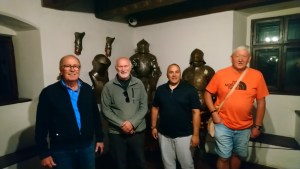
Moving on, our next stop was the infamous Bran Castle, known far and wide (and especially outside Transylvania) as Dracula’s Castle. It’s marketed with admirable enthusiasm as the one-time home of Bram Stoker’s iconic vampire, despite the historical connection being, shall we say, tenuous at best.
Perched dramatically on a rocky outcrop near the Bran Pass, the first known fortress here was constructed in 1211 to defend a vital trade route threading through the Carpathian Mountains. By 1388, the castle had taken on a more administrative role, serving as a customs house for Transylvania, which was then part of Hungary.
As for Bram Stoker, our favourite fang-fiction pioneer, he never actually set foot in Transylvania, let alone in Bran Castle. His vivid Gothic imagination was fuelled by research and second-hand tales rather than personal experience. And while Vlad the Impaler (a.k.a. Vlad III Dracula), the bloodthirsty 15th-century Wallachian ruler so often linked to the Dracula legend, may have passed through the area, there’s no solid evidence he ruled from Bran. Some sources claim he was briefly imprisoned there, though whether in a cell or simply stuck in a long queue for the gift shop remains unclear.
Still, the castle doesn’t let facts get in the way of a good story. With its looming towers, creaky corridors, and dramatic mountain setting, it certainly looks the part. And if you’ve got a spare £60 million lying around, you could even call it home, assuming you don’t mind a few thousand tourists a day wandering through your living room.
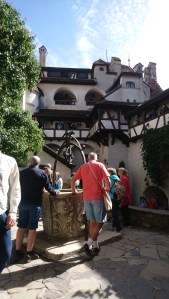

As Bran Castle is relatively small and immensely popular with tourists, our guide wisely opted to give us the historical lowdown en route, allowing us to explore the site at our own pace once inside. Entrance is via a steep set of stone steps which lead into a modest ante-room, just to lull you into a false sense of security, before climbing sharply again through a narrow passageway that would challenge even the nimblest mountain goat. This is definitely not a tour for the infirm or the claustrophobic.
The rooms, though atmospheric, are far from grand, certainly a far cry from the opulence of Peleș Castle. As we shuffled along with the tourist throng, we managed to squeeze ourselves through each of the designated rooms, which are linked by a maze of tight corridors, narrow staircases, and the occasional low beam daring you not to duck (Sean found out the hard way!).
There were optional extra exhibits to explore, a torture chamber and a Dracula exhibition, both at additional cost, but we gave them a miss. The idea of queuing to see a rack or rusty thumb screws held limited appeal. Instead, we made a beeline for the tourist stalls just outside, where the usual array of garlic trinkets, Dracula mugs, and vaguely medieval weaponry awaited, before retiring to a nearby village bar for more refreshments and a well-earned sit-down.
Bran Castle is a must-see for Dracula devotees and those squeezing Romania into a short itinerary. Despite the crowds and creaking staircases, it’s an authentic Romanian fortress that offers a genuine glimpse into medieval life. Whether you’re captivated by vampire lore or simply have a soft spot for castles with character, it’s an experience bound to linger in the memory, just hopefully not in the form of neck puncture marks.

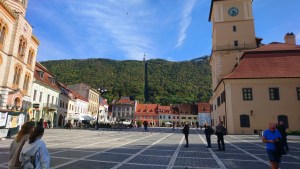
Our final scheduled stop was Brașov, founded in 1211 by the Teutonic Knights. In the 13th century, it was settled by the Saxons and swiftly became one of Transylvania’s famed seven-walled citadels. It’s perhaps best known for two standout features: the Black Church, the largest Gothic structure in Romania, so named after its exterior was blackened by flames and smoke during the Great Fire of 1689; and Rope Street, one of the narrowest streets in Europe, measuring a cosy 3.6 to 4 feet wide and stretching 265 feet in length. It connects Strada Cerbului with Strada Poarta Schei and is not for the broad-shouldered or claustrophobic.
Despite their fame, we opted to skip both. Instead, like most of our tour group, we found ourselves irresistibly drawn to the sun-drenched Old Town Hall Square (Piața Sfatului), a grand space surrounded by colourfully painted, ornately baroque buildings that look like they’d been plucked straight out of a fairy tale. We passed a very pleasant couple of hours there, happily seated at an outdoor table, chatting away and enjoying plates of authentic Romanian cuisine, generously accompanied by local refreshments. It was cultural immersion, albeit of the more relaxed and digestible variety.
Our return to Bucharest was straightforward, just one brief toilet break, until we reached the capital’s predictably frantic traffic. Deposited once again at Piața Universității, we dove back into the Old Town and tucked ourselves into a charming little wine bar. There, we shared a fine bottle of Romanian red, reflecting on the day’s highlights before eventually wending our way back to the hotel for a well-earned rest.
4th October 2024: Villages and Rugby
By 8 a.m., we were at breakfast, enjoying the hotel buffet and debating how best to spend the day. Consensus was reached over coffee and scrambled eggs: we would visit King Michael I Park, a sprawling green oasis in northern Bucharest, wrapped around Lake Herăstrău. Our main draw was the National Village Museum, an open-air collection of dozens of homesteads, churches, mills, and windmills relocated from rural corners of Romania. Built by royal decree in 1936, it’s one of Europe’s oldest open-air museums and promises a glimpse into Romania’s rustic past.
After a slightly longer-than-anticipated taxi ride, we arrived, ready to explore, with only a vague idea of what awaited us beyond the gates.
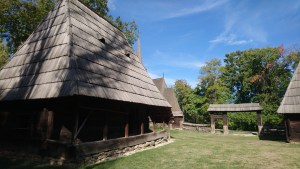
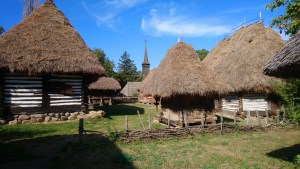
It was a lovely, warm day, ideal for a leisurely ramble. After paying the modest entrance fee of 15 Lei, we spent the next couple of hours wandering through the remarkable village of “Dimitrie Gusti”. We found it genuinely fascinating. The museum offers a window into traditional Romanian village life and comprises 123 authentic peasant dwellings, 363 individual monuments, and over 50,000 artefacts sourced from across the country, spanning from the 17th to the 20th century.
The grounds were extensive, and each twist and turn revealed something new, a wooden church here, a thatched mill there, each structure thoughtfully relocated and beautifully preserved. Partway through our exploration, we gratefully paused at a lakeside café to escape the midday sun and rehydrate with something cold.
Feeling suitably refreshed and satisfied with our cultural efforts, we consulted a nearby map and noticed that the Romanian National Rugby Stadium was just a short walk away. Never ones to miss an opportunity for a bit of sporting pilgrimage, we left the park behind and made our way to the Arcul de Triumf National Rugby Stadium, the proud home of the Romanian national rugby union team.
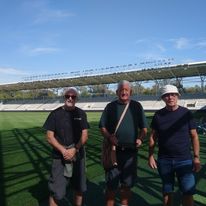
It was only a short walk, but as ever, negotiating Bucharest traffic proved a challenge. The stadium itself was closed, but we discovered a small cabin selling Romanian national rugby kit and stepped inside for a chat. Sadly, the two individuals manning the stand had no interest in or apparent knowledge of the sport. They were simply there to sell what was on the racks.
Nonetheless, we managed to locate an unattended gate that allowed a brief glimpse of the pitch. Cameras in hand, we took a few quick photos before a vigilant security guard spotted us and politely but firmly escorted us out.
We wandered back to the park and, not far from the Hard Rock Café, came across a lively complex of bars and restaurants. Finding a shady table, we ordered a satisfying meal, cooled off with drinks, and indulged in a spot of people-watching.
We had intended to catch a taxi back into the city, but feeling adventurous, we opted for the bus. After discovering we needed the number 331, one miraculously appeared. We hopped on, ticketless and unsure how to pay, only to be informed by a fellow passenger that the card terminal didn’t work, so our ride was, apparently, free. Fate was clearly on our side.
Alighting the bus, we walked the now-familiar twenty minutes to the Old Town, where we enjoyed another meander through several bars before heading back to the hotel.
Later that evening, we tried to dine at a restaurant recommended by our guide from the previous day. The outing began poorly, the taxi driver overcharged us, and upon arrival, we were told there would be at least a forty-minute wait for a table. Undeterred, we wandered just one street away and found a perfectly acceptable alternative. We ordered goulash and a bottle of wine, then followed it up with a round of beers. Content, we remained there for the rest of the evening, enjoying the relaxed atmosphere, soaking up the music, watching the locals, and sharing reflections on our time in Romania. This time, the taxi ride home was uneventful.
5th October 2024: Parliament Palace and Home
We breakfasted at 8 a.m. once more, then checked out of the hotel, leaving our luggage safely behind reception before heading off for a final adventure: a visit to Parliament Palace.
Also known as the House of the Republic, People’s House, or People’s Palace, it is the seat of the Romanian Parliament. Famously vast, it is the largest and heaviest administrative building in the world used for civilian purposes, second only in overall size to the Pentagon.
The Palace was Nicolae Ceaușescu’s centrepiece in his sweeping (and devastating) redesign of Bucharest, intended as a grand statement to the world of Romania’s strength and socialist prosperity.


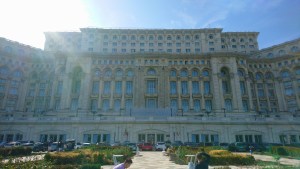
The Reception at the hotel had kindly booked us onto a tour the previous day, as these can only be arranged 24 hours in advance and must be done over the phone. Upon arrival at Parliament Palace, we were required to present our passports and were issued orange identification tags. After a stern warning not to stray from the group, we followed our guide through a succession of immense rooms, each with its impressive decor. It is, without doubt, a grand edifice, monumental in every sense!
Thankfully, due to time constraints, we took the Standard Tour, which covers just 4% of the building’s staggering 1,100 rooms. The Palace is one of Bucharest’s most visited tourist attractions and stands as a symbol of the excesses of the communist era. One cannot leave the building without being both awed by its vast scale and struck by the sheer waste of materials, manpower, and ambition poured into fulfilling the grandiose vision of one couple.
Back at the hotel, we collected our bags and took a taxi to the train station. Tickets were easily purchased from a machine, and we found a place in the station concourse to enjoy a light lunch of sandwiches.
The train to the airport was packed, but we were lucky enough to find seats. Unfortunately, our flight was delayed by two hours, and we didn’t land at Stansted until around 9 p.m. Thankfully, the motorway was quiet, and we made good time on the drive to Harborough, dropping Suraj off in Rothwell before arriving home at 11:30 p.m.


Leave a comment